

What you’re really standing on at Nubble Light and the Marginal Way: Nature News
Geology is a topic I’m always afraid to write about, mostly because it is so complicated, and whenever I try to dive a little deeper into anything geological, I find myself out of my depth fairly quickly.
To help remedy this, I recently took a Geology 101 workshop sponsored by the Great Works Regional Land Trust in Ogunquit, Maine.
In this workshop, geologist and teacher Don Wason started by reminding us of the three basic rock types: sedimentary rocks, the ones formed by the deposition and compaction of sediments under pressure; igneous rocks, which are formed from molten magma; and finally, metamorphic rocks, formed when either sedimentary or igneous rocks are exposed to enough heat and pressure to alter the rock's mineral structure and texture without melting it completely, creating new, denser rock types. Following this, we went out and explored two locations: Nubble Light in Cape Neddick, Maine, and Ogunquit’s famous Marginal Way.
The kinds of rocks you’ll find along the coast of southern Maine are quite different from those in other parts of the state. You have to think impossibly far into the past to begin to get a grasp on what formed our coastline.
Some parts of the Maine coastline are quite young, at approximately 118 million years old, such as parts of Cape Neddick. However, most is quite old, like the Kittery Formation at 400-plus million years old, and is of a different composition than inland Maine, formed from a collision between the Avalon terrane, a chunk of rock that originated elsewhere, and North America. It is thought to be the last big piece of bedrock added to the coast of what we now know as Maine and New Hampshire.
If you look at a geological map of the Nubble Light, you’ll see a bright pink circle called the Cape Neddick Complex. Nubble Light is located on the outer edge of a larger circular mass (an even brighter pink on the map, not in real life) of igneous rock called a pluton, remnants of a magma chamber.
According to D. W. Caldwell’s "Roadside Geology of Maine," this is the Cape Neddick pluton, perhaps the youngest rock in Maine, formed roughly 118 million years ago.
Wason brought this to life by taking us to Nubble Light. We gazed across the little channel separating Nubble Island from the mainland while he explained that we were standing on what used to be the edge of a giant magma chamber. Instead of erupting as a volcano, which can happen with a magma chamber, a large underground pool of molten rock, this magma cooled slowly, forming a pluton that, over time, rose to the surface. As it did, it expanded, forming cracks and crevasses in the rock. When looking at Nubble Island, you can see that it is curved, following the lines of the pluton that it slowly peeled away from.
The Cape Neddick Complex is a younger, igneous rock that intruded up into the pre-existing rock, the Kittery Formation, a metamorphic rock that formed 425 million years ago. This was before Pangea formed, between 300 and 335 million years ago, and well before Pangea broke apart into the continents we know today, 175 to 200 million years ago. While this seems impossibly ancient, it is actually not so old, given the 4.5-plus-billion-year history of planet Earth.
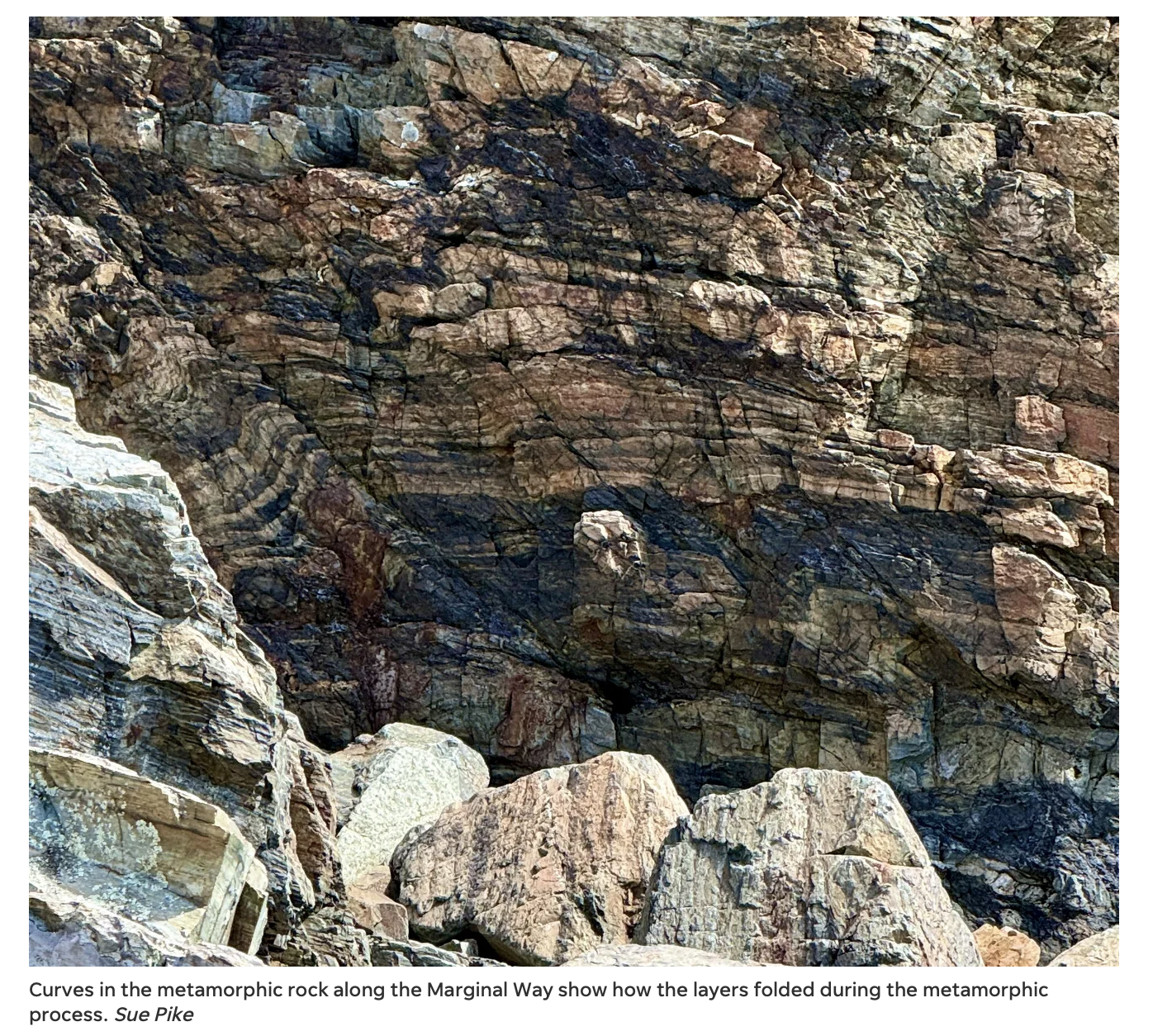
Photo from Seacoastonline.com Article
The Kittery Formation is composed of layered sedimentary rock, sandstones, and mudstones that have been metamorphosed, changed by heat and pressure. You can still see the layering from when this was sedimentary rock, but it is often distorted into wavy lines. There are even places where you can see the rock folded back on itself during metamorphism. Look for this next time you visit the Marginal Way. Look also for the informational sign that points out many of the geological highlights.
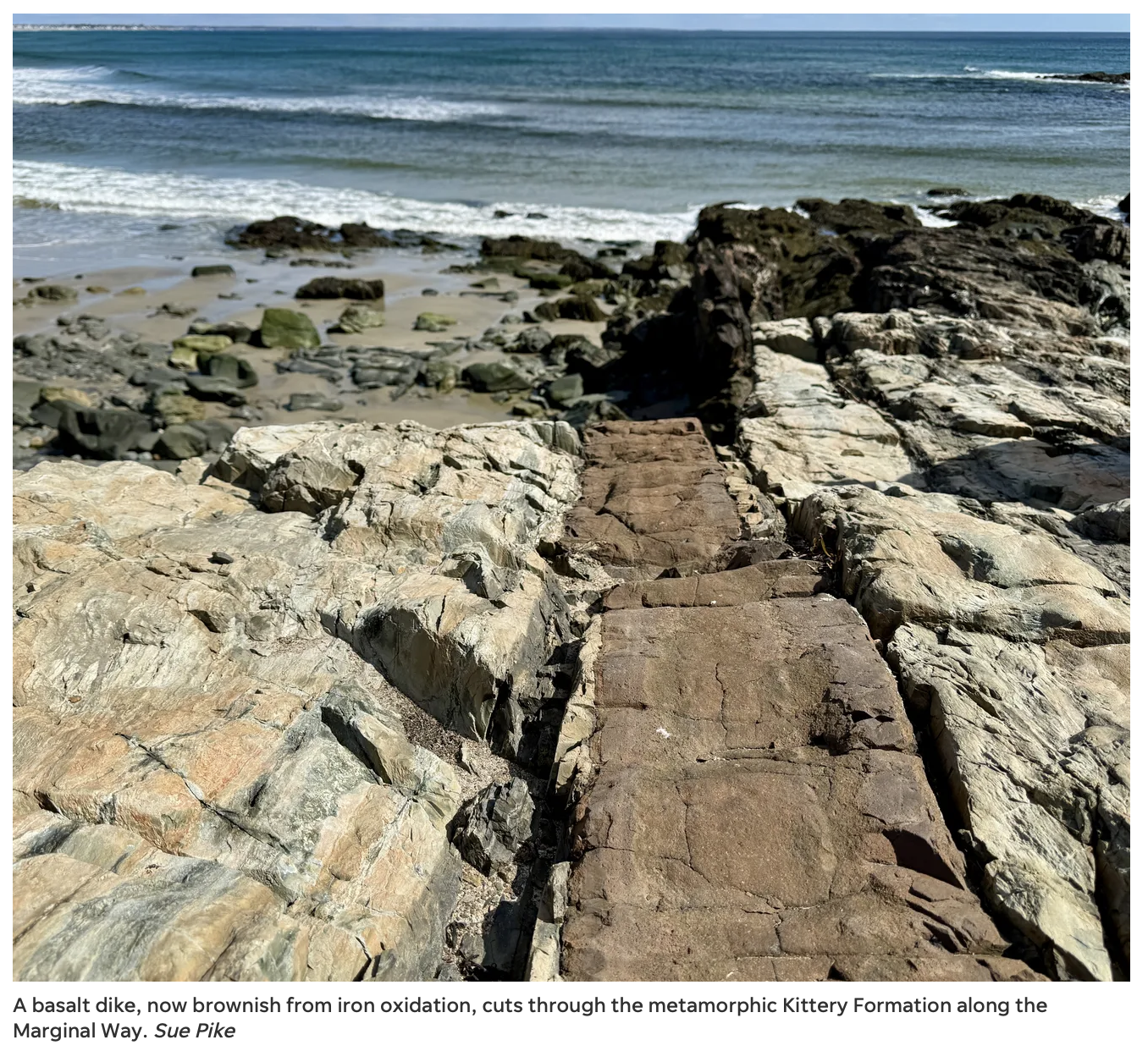
Common to both the Marginal Way and the Nubble is evidence of cracks in the pre-existing rock: basalt dikes. Whenever you are looking at rocks and notice a band of darker rock, often brownish, cutting through the existing rock, you are probably looking at a basalt dike. Stretching and rifting of the crust as Pangea broke apart allowed rapidly cooling, iron-rich magma to rise from the mantle and fill in cracks in the overlying rock layers. One fun fact: as the basalt ages, it often turns brown or rusty, as the iron oxidizes when exposed.
Next time you walk the Marginal Way or gaze out at Nubble Light, take a moment to look down. You may find yourself standing on a story hundreds of millions of years in the making.
Susan Pike, a researcher and an environmental sciences and biology teacher at Dover High School, welcomes your ideas for future column topics. Send your photos and observations to spike3116@gmail.com. Read more of her Nature News columns online at Seacoastonline.com and pikes-hikes.com, and follow her on Instagram @pikeshikes.